Posts

The Stomach

The stomach is the principal organ of digestion. It is the most dilated part of the alimentary canal, and is situated between the termination of the esophagus and the commencement of the small intestine. Its form is somewhat pyriform with the large end (fundus) directed upward and the small end bent to the right. It is situated in the left hypochondriae and epigastric regions, and is placed, in part, immediately behind the anterior wall of the abdomen and beneath the Diaphragm. Viewing the stomach from in front it appears that the right margin of the esophagus is continued downward as the upper tow-third of this border bending sharply backward and to the right, to complete the smaller curvature. The greater curvature begin at the left border of the termination of the esophagus in a somewhat acute angle; it lies in contact for some distance, and then sweeps downward with a convexity to the left and continued across the middle line of the body, finally turns upward and backward, to t...
Excretory System

Excretory systems are special structures in organism through which waste products of metabolism are rid and the proper balance of water and salts in the blood and other body fluids is maintained at the same time. Detection is the elimination of undigested material from the body and is a function of the digestive system. Urinary system The major excretory organs in vertebrates are the kidneys , which are two paired organs, one on each side of the body. The kidneys and associated organs that store and eliminate urine are collectively called the urinary system. The kidneys dispose of toxic wastes, such as ammonia, urea and uric acid, and excess salt and water in the form of urine. The heart, in a sense, pumps blood blindly, but the kidneys monitor the quality of blood so that the organism is not poisoned by the end products of its own metabolism and the proper volume and composition of its body fluids are maintained. The kidneys continually form urine by filtering many material...

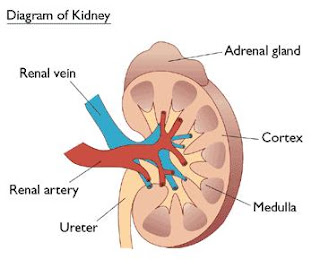
Kidneys

Image
The two kidneys are the major organs of excretion in vertebrates. Excess water, toxic waste product of metabolism such as urea and uric acid , and organic salts are disposed of by the kidneys in the form of urine. The kidneys are also largely responsible for maintaining the water balance of the body and the acidity (PH) of the blood. The kidneys and associated organ that produce and eliminate urine are collectively called the urinary system. The kidneys also play important roles in other body activities such as in releasing the protein erythropoietin, which stimulate the bone marrow to increase the formation of cell blood cells, and in helping in control blood pressure. Some drugs or their breakdown products are eliminated through the kidneys. Because of this important function of kidneys, we should always give a best maintainance service to this organ. The tips for maintain our kidneys are must much of drink and always go sport even just light sport, the important of this sport...

Larynx

Image
The larynx or voice box, is a muscular tube in the throat of all mammals and some reptile and amphibians. It contains the vocal cords, which produced sound that is converted into speech and other utterances by the lips, teeth, and tongue. Birds do not have a larynx , but most have a modified portion of the wind pipe called the syrinx with which they vocalize. The larynx has several segments of firm, elastic cartilage held together by muscle and ligament. The largest segment, the thyroid cartilage, consists of two plates that form a ridge, called the “Adam’s Apple.” The larynx extend from the pharynx (throat) above the tracheae (windpipe) below. In mammals, including humans, the larynx has a flap-like structure, the epiglottis, at its inlet. The epiglottis caused swallowed food to pass from the throat into the esophagus rather than into the tracheae. The vocal cords, located in the upper region of the larynx, are two muscularized fold of mucous membrane that extend from the larynx wall....

Pancreas

A long, thin organ in humans, the pancreas has both digestive and endocrine functions and for this reason contains two completely different types of cells. Measuring about 12- 15 cm (5-6 in) long, it is nested within the curve of the duodenum and hind the stomach, in front of the spine and aorta. The digestive, or exocrine, cells of the pancreas consist of a number of organ, small lobules, or acinar cells, joined together into small ducts that, in turn, joint the two major ducts of Santorini and Wirsung, which empty through small muscular opening into the duodenum. The lobules contain numerous cells that secrete pancreatic secretion containing electrolytes and three important digestive enzymes, typsin, amylase, and lipase. The enzyme digest protein, spilt fat, break down highly polymerized nucleic acid, and break down polysaccharides such as starch, amylopectin, and glycogen. The protein splitting enzyme typsin becomes active only when the duodenal enzyme enterokinase is mixed with i...

Nose

The nose, the site of the sense of smell is the organ through which mammals take in air. It is supported by cartilage and bone, covered with skin , lined with a mucous membrane, and provided with muscle. A nasal septum divides it into passages, each of which begins with a vestibule and contains a respiratory and olfactory region. The lining of the vestibule is continuous with the skin and contains hairs, sweat glands, and sebaceous (oil producing) glands . The respiratory region includes nearly all of the septum and the lateral walls of the nose. Goblet cells, which produce and secrete a watery mucus, are present in the lining, as is a type of erective tissue, composed of large, thin-walled veins whose blood supply serves to warm incoming air. The olfactory region is located on the superior concha and adjacent septum. Olfactory cells are present in its lining and have delicate, slender process (modified cilia) at their free surface. Odors from chemicals in the air are received by ...